
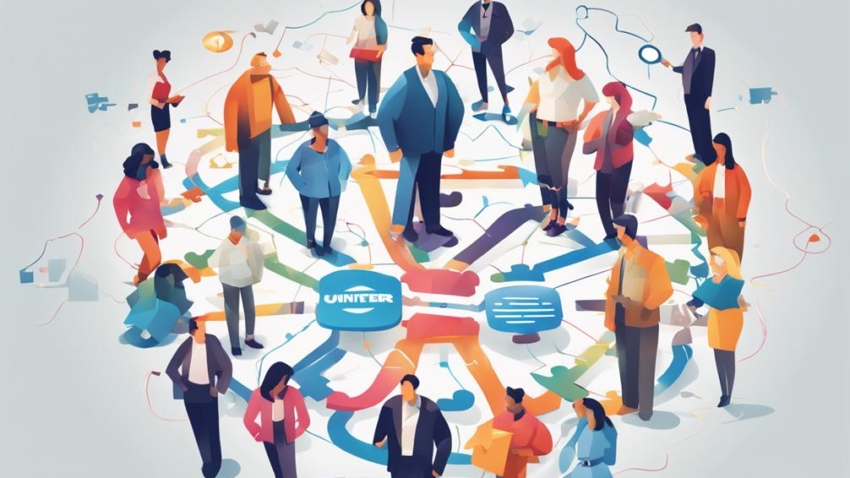
Championing Customer Loyalty Through Personalized Experiences
You're fighting to stand out in a crowded marketplace where customer loyalty hinges on personalized experiences. To champion loyalty, start by crafting unique customer profiles that reveal their preferences and motivations. Then, harness the power of data-driven personalization to tailor experiences across channels. Humanize interactions with empathy, and measure success beyond traditional metrics. By understanding emotional resonance, value alignment, and pain points, you'll uncover opportunities to build lasting relationships. As you prioritize customers' emotional needs, you'll create experiences that foster loyalty and set you apart from the competition – and there's more to discover.
Crafting Unique Customer Profiles
By analyzing customer interactions and behaviors, you can create detailed profiles that capture the nuances of each individual's preferences, behaviors, and motivations. This process involves segmenting your customer base into distinct groups, each with its own unique characteristics. By doing so, you can develop a deep understanding of their needs, values, and pain points. This is where customer archetypes come into play. Archetypes are hypothetical models that represent a set of characteristics, behaviors, or preferences shared by a group of customers. By identifying these archetypes, you can create a profile hierarchy that categorizes customers based on their similarities and differences.
A well-structured profile hierarchy enables you to prioritize your customer segments, allocate resources effectively, and tailor your marketing strategies to resonate with each group. For instance, you might have a segment of tech-savvy customers who value innovation and convenience, while another segment prioritizes sustainability and eco-friendliness. By recognizing these differences, you can craft personalized experiences that speak directly to their needs and aspirations. By mastering the art of customer profiling, you'll be able to anticipate their needs, exceed their expectations, and foster a deep sense of loyalty that drives long-term growth and success.
Embracing Data-Driven Personalization
You're now positioned to harness the full potential of your customer profiles by incorporating data-driven personalization, which enables you to tailor your interactions with precision and relevance. By leveraging the rich insights gathered from your customer profiles, you can create highly targeted and engaging experiences that resonate with your audience. This is where predictive modeling comes into play, allowing you to forecast customer behavior and preferences with uncanny accuracy.
By applying predictive modeling to your customer data, you can identify distinct customer clusters that share similar characteristics, behaviors, and preferences. These clusters serve as the foundation for crafting personalized messages, offers, and experiences that speak directly to each group's unique needs and desires. For instance, you might identify a cluster of high-value customers who consistently purchase premium products. By recognizing this pattern, you can develop targeted campaigns that reward their loyalty and encourage continued investment in your brand.
As you explore further into data-driven personalization, you'll uncover opportunities to refine your marketing strategies, optimize customer journeys, and foster meaningful connections with your audience. By embracing this approach, you'll be well on your way to creating a loyal customer base that advocates for your brand and drives long-term growth.
Tailoring Experiences Across Channels
As you venture into the world of omnichannel personalization, your brand's ability to tailor experiences across channels becomes a critical differentiator in fostering seamless customer engagement. You're no longer limited to a single touchpoint; instead, you can craft a cohesive narrative that unfolds across multiple channels, devices, and interactions. This is where omnichannel strategies come into play, enabling you to synchronize your messaging, visuals, and tone across various platforms.
To achieve this, you'll need to develop channel-specific content that resonates with your audience on each specific platform. For instance, your social media content might be more conversational and visually driven, while your email campaigns might focus on personalized offers and loyalty rewards. Meanwhile, your website could provide in-depth product information and customer reviews. The key is to understand the unique strengths and limitations of each channel and tailor your content accordingly.
Humanizing Interactions With Empathy
When you prioritize empathy in customer interactions, you create a safe space for customers to share their concerns and emotions, allowing your brand to respond with compassion and understanding. By doing so, you humanize your brand, making it more relatable and trustworthy. This empathetic approach fosters deeper connections, driving customer loyalty and retention.
To effectively humanize interactions, you need to develop Emotional Intelligence, which enables you to recognize and understand customers' emotional cues. This allows you to respond in a way that acknowledges and validates their feelings. For instance, when a customer expresses frustration with a product, an empathetic response might be, 'I can imagine how frustrating that must be for you. Let me see what I can do to help.' This kind of response shows that you're actively listening and care about the customer's experience.
Active Listening is an important aspect of empathetic interactions. When you actively listen, you focus on the customer's concerns, ask clarifying questions, and paraphrase their statements to confirm understanding. This helps to build trust and demonstrates that you value the customer's time and input. By combining Emotional Intelligence with Active Listening, you can create personalized experiences that address customers' emotional needs, leading to lasting loyalty and advocacy for your brand. By prioritizing empathy, you'll be well on your way to building a loyal customer base that will drive long-term success.
Measuring Success Beyond Metrics
By moving beyond traditional metrics, you can uncover the emotional resonance of customer experiences that drive loyalty and retention. You've likely tracked metrics like customer satisfaction (CSAT), net promoter score (NPS), and customer effort score (CES), but these alone don't paint the full picture. To truly understand what drives customer loyalty, you need to measure the intangible aspects of their experiences.
One way to do this is through value alignment. By understanding what your customers value most, you can tailor your experiences to meet those expectations. For instance, if your customers prioritize convenience, you can optimize your processes to reduce friction and make interactions seamless. This alignment builds trust and fosters loyalty.
Journey mapping is another essential tool for measuring success beyond metrics. By mapping the customer's journey, you can identify pain points, areas of delight, and opportunities to improve. This visual representation helps you understand the emotional highs and lows of the customer's experience, allowing you to make targeted improvements. By combining value alignment and journey mapping, you'll gain a deeper understanding of what drives customer loyalty and retention. This insight will help you create personalized experiences that resonate with your customers on an emotional level, ultimately driving long-term loyalty and growth.
Frequently Asked Questions
Can Personalized Experiences Be Scaled for Large Customer Bases?
You're wondering if personalized experiences can be scaled for large customer bases. The answer lies in technology integration and customer segmentation. By leveraging advanced analytics and automation, you can create tailored experiences for diverse customer groups. Segmenting your customer base allows you to identify common needs and preferences, making it possible to personalize at scale.
How Do I Balance Personalization With Customer Data Privacy?
You're walking a tightrope between making customers feel seen and respecting their privacy. To balance personalization with data privacy, you'll need to prioritize data anonymity, ensuring sensitive info remains abstracted. Implementing robust consent management is also essential, allowing customers to opt-in and control their data sharing. By doing so, you'll build trust and demonstrate a commitment to protecting their digital footprint.
What Role Does Employee Training Play in Personalized Experiences?
You acknowledge that employee training is essential in delivering personalized experiences. By empowering your employees, you're enabling them to make informed decisions that cater to individual customers' needs. Effective training enhances their skills development, allowing them to tailor interactions that foster loyalty. When you invest in your employees, they'll be better equipped to collect and utilize customer data responsibly, ultimately driving personalized experiences that exceed expectations.
Can Personalized Experiences Be Replicated Across Different Cultures?
You’re about to venture into uncharted territory – taking personalized experiences global. But, can you replicate them across different cultures? The answer lies in striking a balance between cultural sensitivity and global consistency. Be prepared to navigate language barriers and regional nuances. It’s a delicate dance: adapt to local tastes while maintaining your brand’s essence. One misstep can mean cultural insensitivity, but get it right, and you’ll reap the rewards of a loyal global customer base. To successfully achieve this, you must understand how to create a brand identity that resonates universally while honoring local traditions. Invest time in research to comprehend the unique preferences and values of each target market, allowing your brand to authentically connect with diverse audiences. Ultimately, this thoughtful approach not only enhances customer loyalty but also positions your business as a culturally aware leader in the global marketplace.
How Long Does It Take to See ROI From Personalized Experiences?
When you invest in personalized experiences, you're likely wondering when you'll see a return on investment (ROI). The timeframe for ROI varies, but you can expect to see cost benefits within 6-12 months. This depends on factors like data quality, implementation speed, and customer engagement. Be patient, as it takes time to build meaningful connections. Set clear timeframe expectations and monitor progress to guarantee a strong ROI.